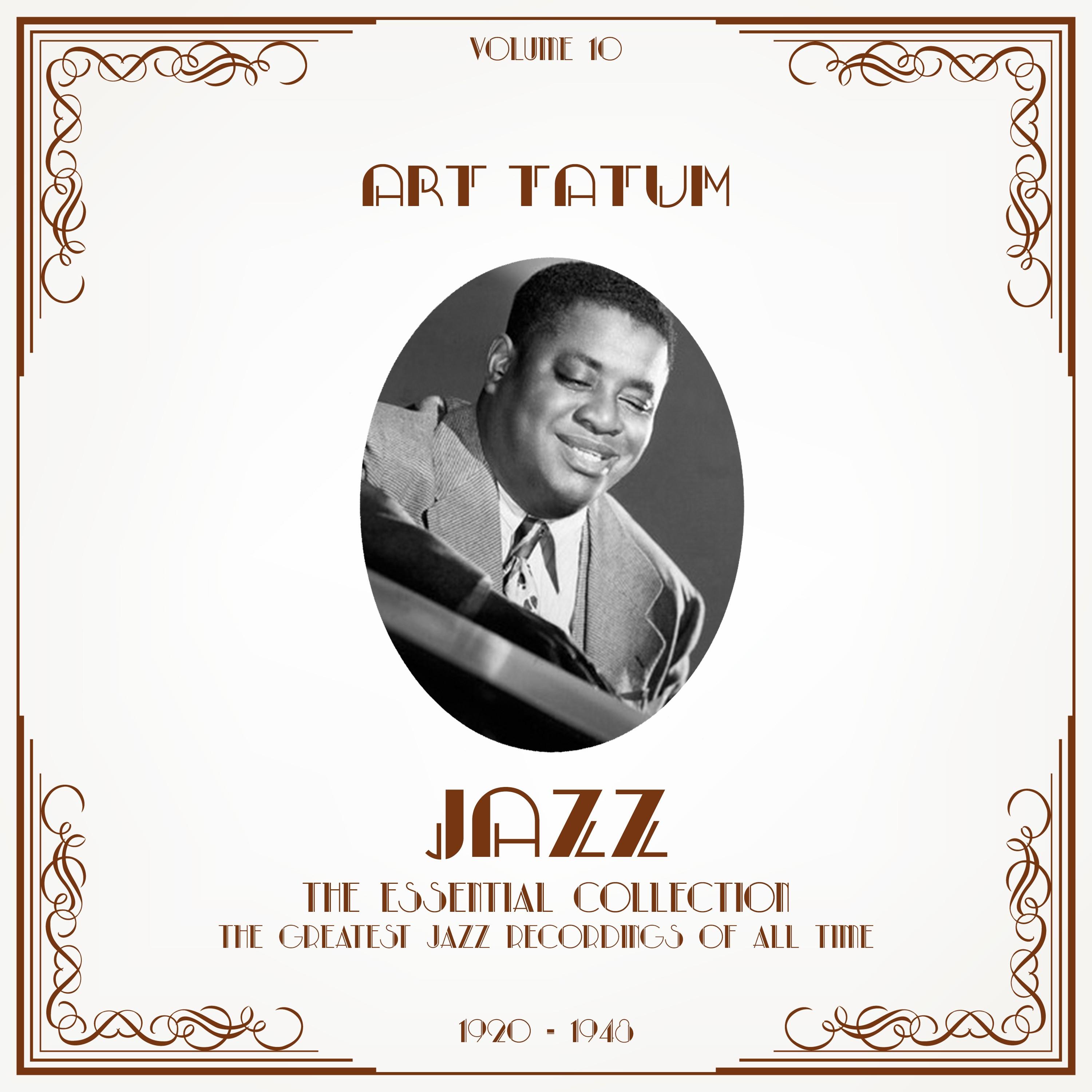
Jazz - The Essential Collection, Vol. 10-Art Tatum曲目列表
|
#
|
歌曲 | 歌手 | 时长 |
|---|---|---|---|
|
1
|
02:47 |
||
|
2
|
The Shout
SQ
|
02:48 |
|
|
3
|
Liza
SQ
|
02:47 |
|
|
4
|
03:10 |
||
|
5
|
03:21 |
||
|
6
|
02:52 |
||
|
7
|
03:12 |
||
|
8
|
Chloe
SQ
|
03:25 |
|
|
9
|
02:43 |
||
|
10
|
02:38 |
||
|
11
|
Deep Purple
SQ
|
03:19 |
|
|
12
|
Elégie
SQ
|
03:17 |
|
|
13
|
03:06 |
||
|
14
|
03:02 |
||
|
15
|
Get Happy
SQ
|
02:46 |
|
|
16
|
03:07 |
||
|
17
|
Tiger Rag
SQ
|
02:16 |
|
|
18
|
02:32 |
||
|
19
|
02:43 |
||
|
20
|
02:50 |
||
|
21
|
02:55 |
||
|
22
|
03:14 |
||
|
23
|
03:10 |
||
|
24
|
My Ideal
SQ
|
03:20 |
|
|
25
|
03:14 |
Jazz - The Essential Collection, Vol. 10-Art Tatum专辑介绍
Tatum was one of the most extraordinary players in the history of an instrument which has never lacked remarkable performers. His stylistic beginnings were in the New York ‘stride’ school and he acknowledged Fats Waller as an early influence. His first recordings offered over-decorated exploitations of ‘stride’ resources and it is enlightening to compare that early Tiger Rag with the still amazing, yet far more disciplined 1940 version included here. During the several years leading up to the latter account, Tatum transformed external filigree into essential detail. A tireless listener, he was gifted with a rare musical curiosity, with an ear as exceptional as his technical skill; and he absorbed every device of piano jazz as it existed in his time. Illustrations include the lightning ‘stride’ bass of Get Happy, a joyous celebration of his music’s roots and framework, and the salon clichés of Massenet’s Elégie or Dvořák’s Humoresque, which are used with such imaginative grace that their meaning is restored. Note also The Shout, one of Tatum’s few compositions, which salutes the despised ‘novelty’ piano idiom that was another of his sources. This may be contrasted with Rosetta, appropriately a Hines theme, on which Tatum demonstrated how much he could do with what he learnt from that earlier master of piano jazz. Wider-ranging is St Louis Blues, which can almost be taken as a miniature history of jazz, passing gradually from boogie woogie tremolos to neo-bop triplets by the end. In short, his music presents a fantastic array of keyboard devices, but we shall be mistaken if we allow this to dazzle us, for it was the smaller part of his achievement. We shall also be misled if we expect him to build new melodies on the chords of the pieces he plays, for Tatum represents, among other things, the final sophistication of ‘stride’ school practices. That is, he used a melody, preferably a well-known ballad such as Liza or Deep Purple, as a cantus firmus around which he evolved a structure of ever-changing textures, full of counter- melodies and inner voices. Sometimes a melody was broken down into its basic motives, which recurred again and again, often modified, usually re-voiced, reharmonised and over various intensifications of ‘stride’ bass patterns. Not surprisingly, many a simple ditty was completely transformed, a good example being Indiana, sometimes the subject of crude dixieland bashes, yet rendered by Tatum as a lyrical, almost gentle, statement, while banal tunes like Chloe of I Ain’t Got Nobody were made the basis of miniature tone poems for the keyboard. Note also the unity-in-diversity of the sequence of episodes which make up Stardust or Elégie, the compact originality of his treatment of Begin The Beguine, the renewed freshness of Cocktails For Two. In such performances is discovered at its fullest the ‘orchestral’ pianism advocated by Jelly Roll Morton, yet even this many-hued diversity of musical resource is not the real point of Tatum. As one recording session followed another, while his virtuosity became more extravagant, the rhythmic invention grew more acute and personal, the harmony grew more complex and sensitive. While a certain part of this music’s expressive force derived from tension between its athletic execution and the sensual complications of its harmony, the overriding point was that Tatum’s staggering technical command was the vehicle of a vast harmonic invention. Those were the elements through which he principally worked and he was, along with Ellington and Tristano, one of the greatest harmonists that jazz has produced. Yet in the same way that general jazz practice by-passed many of Charlie Parker’s rhythmic innovations, it has never assimilated the harmonic potentialities that Tatum uncovered – and it has been the poorer in both cases. Tatum’s rhythmic practice was equally outstanding, though perhaps of less potential innovative significance. He would at times suspend the beat in the left hand without relaxing the tempo – which was still firmly implied in the right – and introduce subtle rhythmic interplay between the hands. Tatum’s later output abounded in this, and in passages where, after a free introduction, he gradually shifted into tempo, the beat gaining definition by barely perceptible degrees. Of course, so brilliant an imagination involved no denial of jazz fundamentals such as the blues, and Tatum was a magnificent blues player. This was often denied by those who found his music rather too complex, and they also pretended that he could not, or would not, play with others. The last four tracks here are among the best possible refutations of this. They are from a December 1943 session held in anticipation of what was supposed to be – or was promoted as – the major jazz event of 1944. That was the Esquire All-American Jazz Concert at the Metropolitan Opera House, which involved some people who are not on this recording and some who are. The main point is that with Cootie Williams, Coleman Hawkins, Oscar Pettiford and Sidney Catlett – if not with Ed Hall and Al Casey – Tatum is heard playing with jazz musicians in his own class, and doing this, in ensembles as well as solos, exceedingly well. Above all, what matters is that he accommodates to this group, so full of strong musical personalities, in so sympathetic a manner. Esquire Bounce is on the chords of Honeysuckle Rose and Esquire Blues has the modernistic touches that might be expected of a period when bop was rapidly approaching. Mop Mop (alias Boff Boff), is on the I Got Rhythm changes, but if this occasion had a particular highlight, it was My Ideal. It is hardly necessary to chronicle the solos one by one on the other pieces, yet it does need to be said that My Ideal belongs to Hawkins and Tatum, who eloquence here can hardly be forgotten. And it could be added that Tatum’s solo on it suggests where Nat Cole and Oscar Peterson got many of their ideas. Much of Tatum’s music can seem elusive at first, but that was not the case on this occasion.