Megadeth热门歌曲下载
查看全部|
|
歌曲 | 专辑 | 时长 |
|---|---|---|---|
|
1
|
Rust In Peace |
05:22 |
|
|
2
|
Let There Be Shred
Hi-Res
|
Let There Be Shred |
03:58 |
|
3
|
Rust In Peace |
06:36 |
|
|
4
|
Tipping Point
Hi-Res
|
Tipping Point |
04:28 |
|
5
|
I Don't Care
Hi-Res
|
I Don't Care |
03:09 |
|
6
|
Puppet Parade
Hi-Res
|
Puppet Parade |
04:40 |
|
7
|
Symphony of Destruction
Hi-Res
|
Countdown to Extinction (Deluxe Edition) |
04:02 |
|
8
|
Hangar 18
SQ
|
Rust In Peace |
05:14 |
|
9
|
Angry Again
SQ
|
Greatest Hits: Back To The Start |
03:47 |
|
10
|
Peace Sells...But Who's Buying? |
04:01 |
Megadeth最新专辑下载
查看全部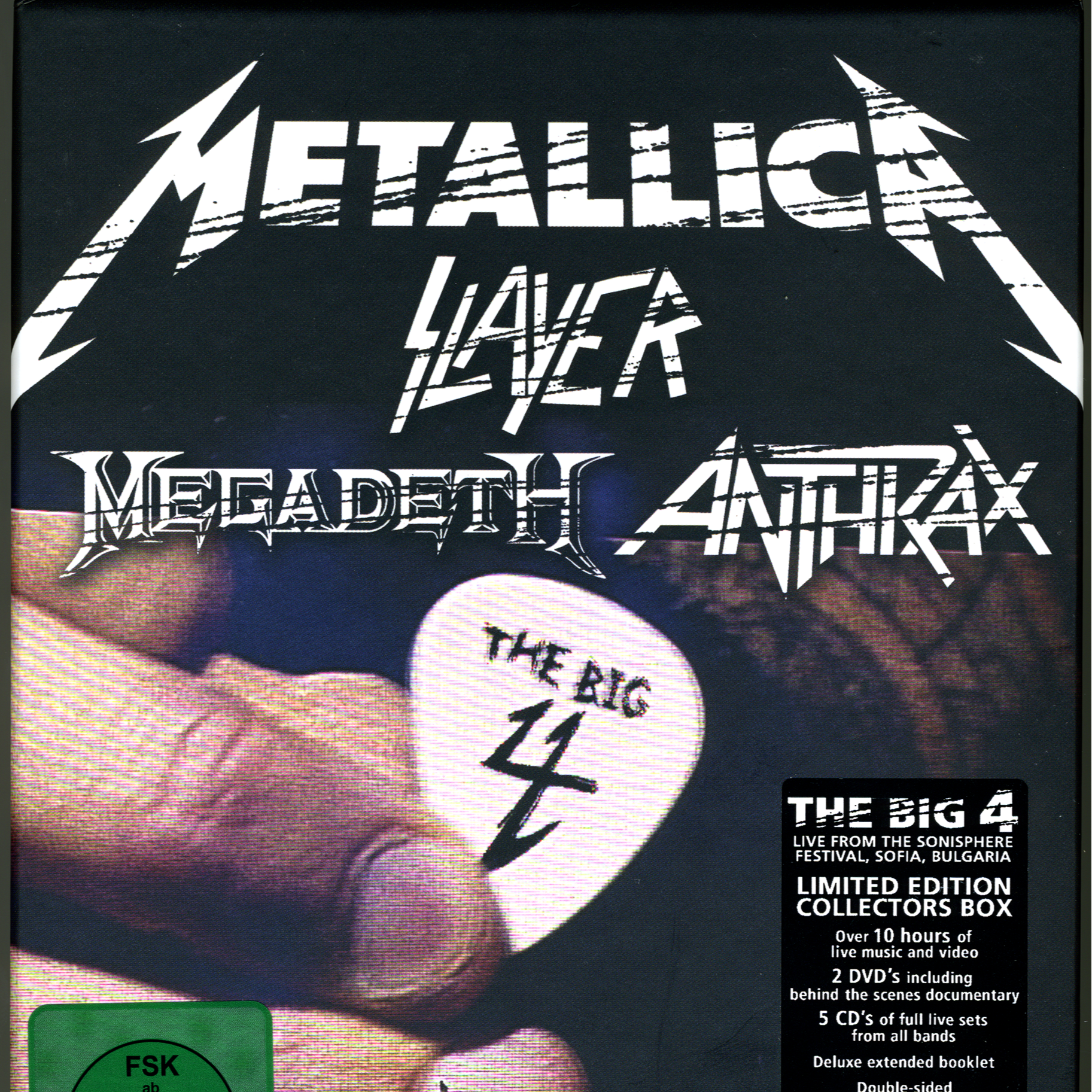
The Big 4: Live From Sofia, Bulgaria
2010-10-29

Megadeth
2026-01-23
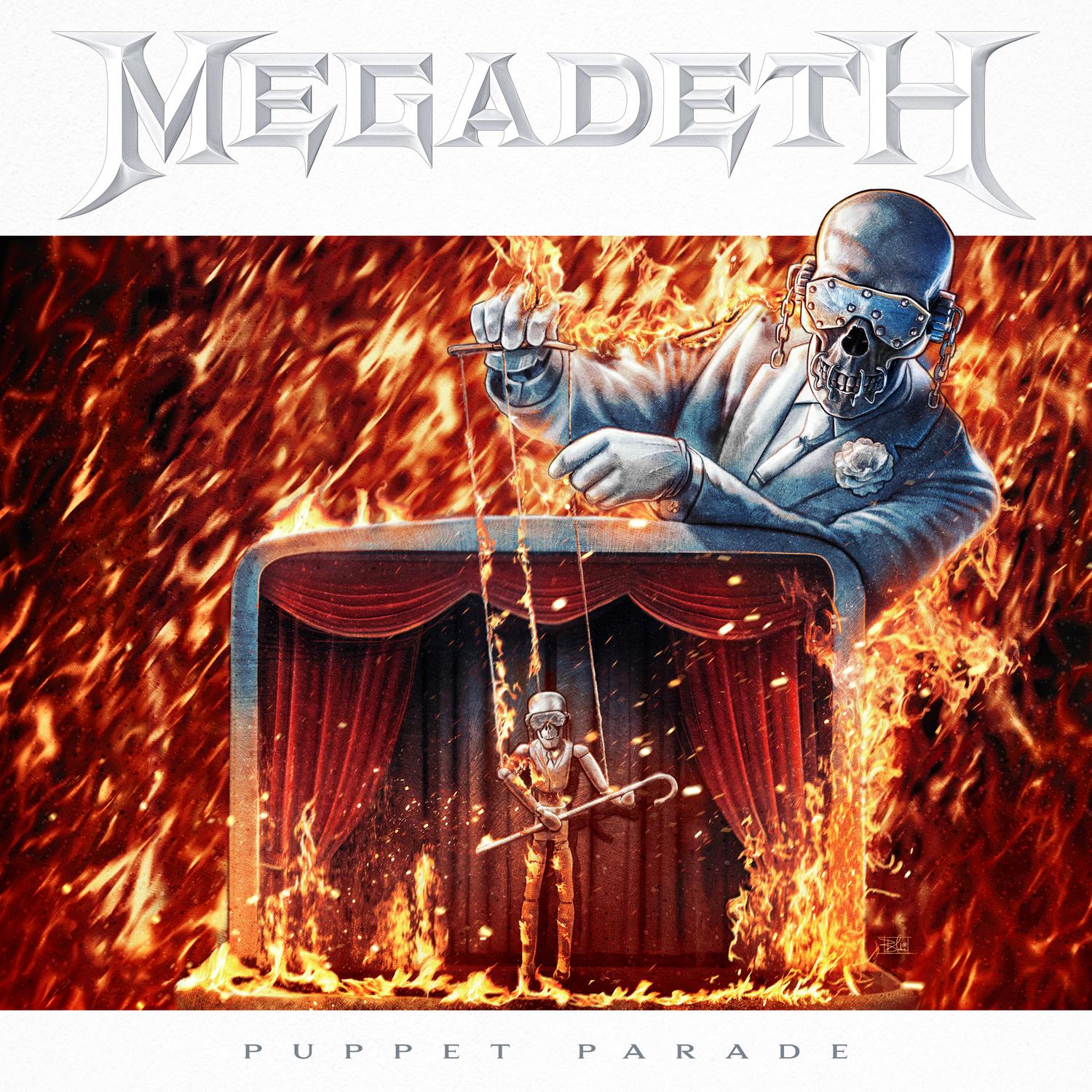
Puppet Parade
2026-01-19
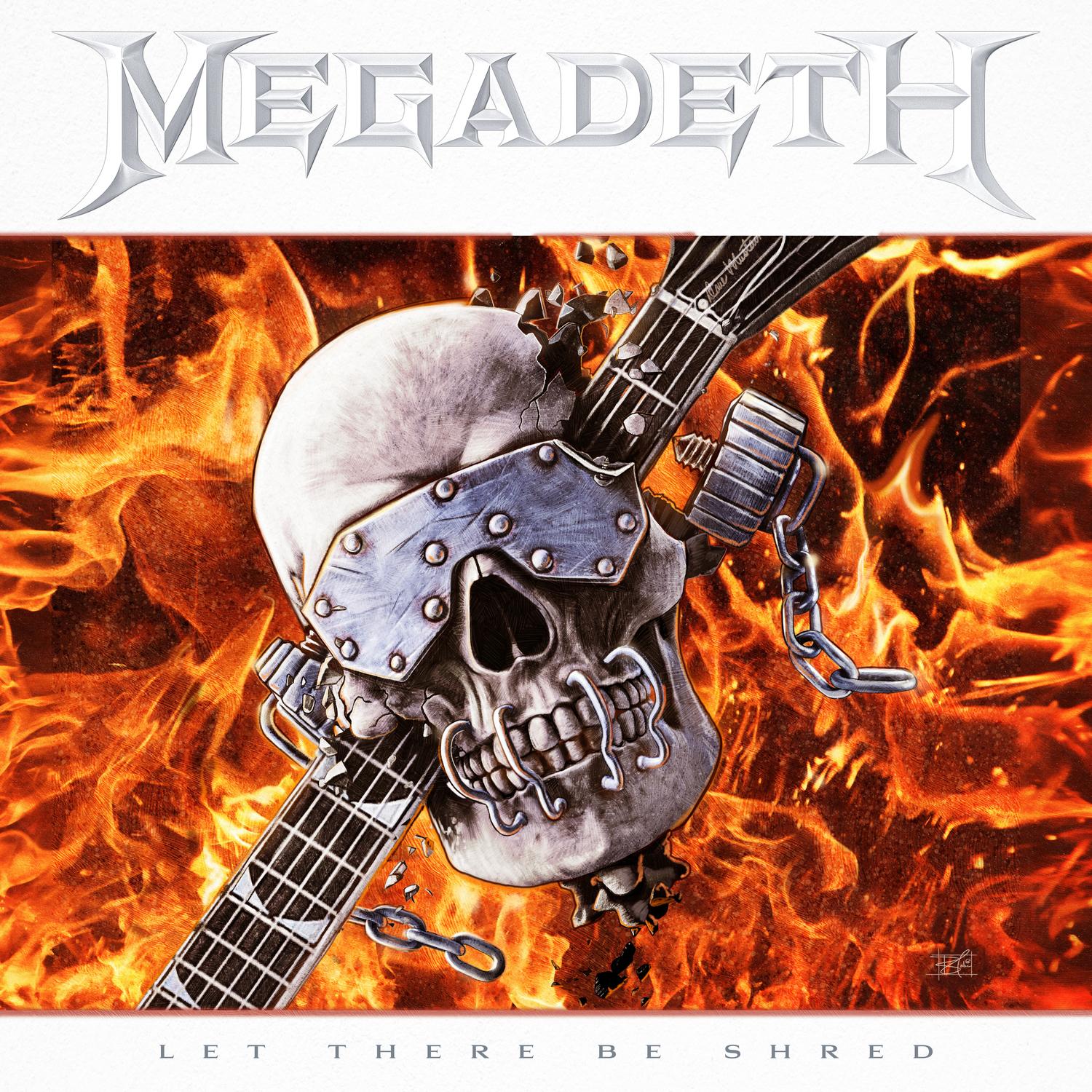
Let There Be Shred
2025-12-19
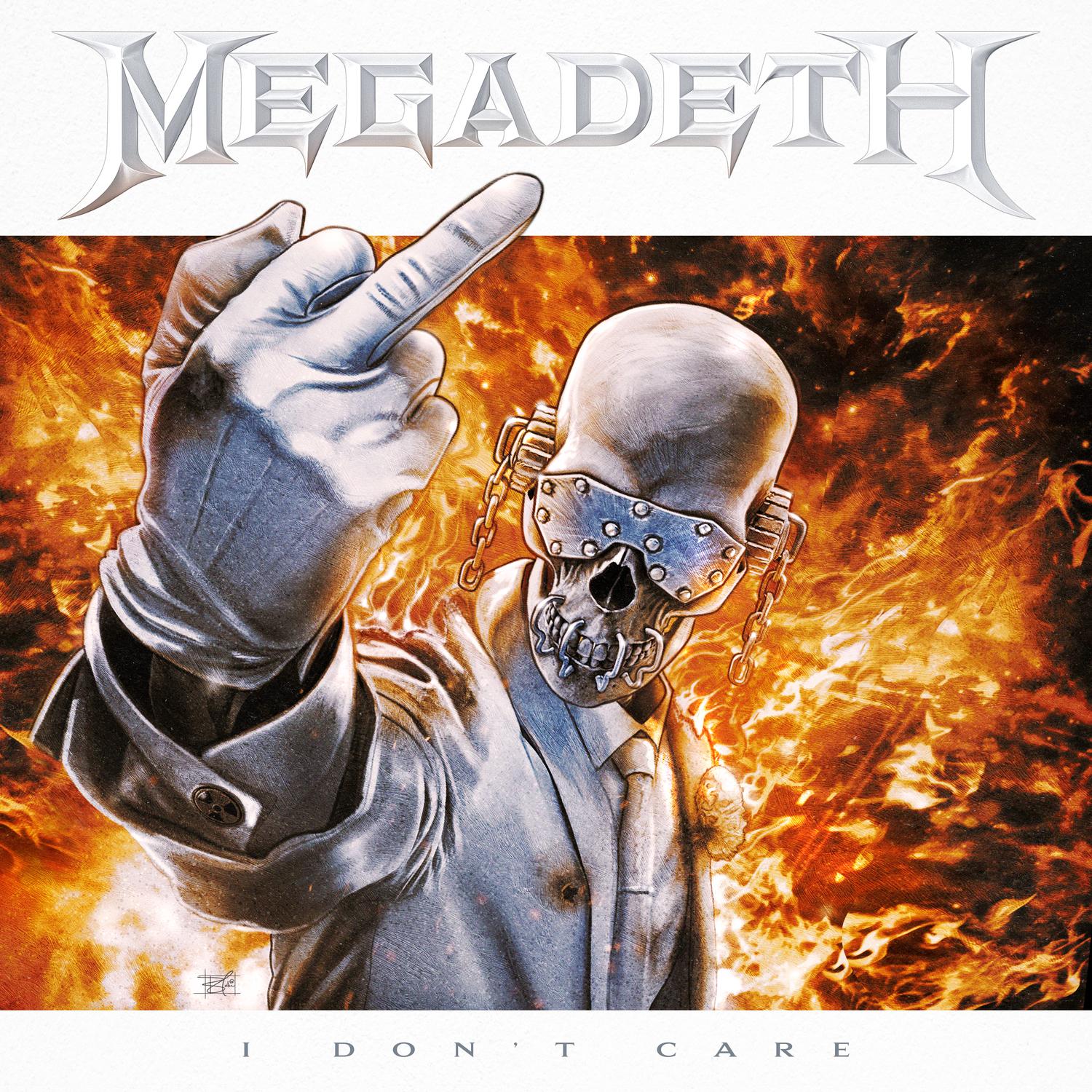
I Don't Care
2025-11-14
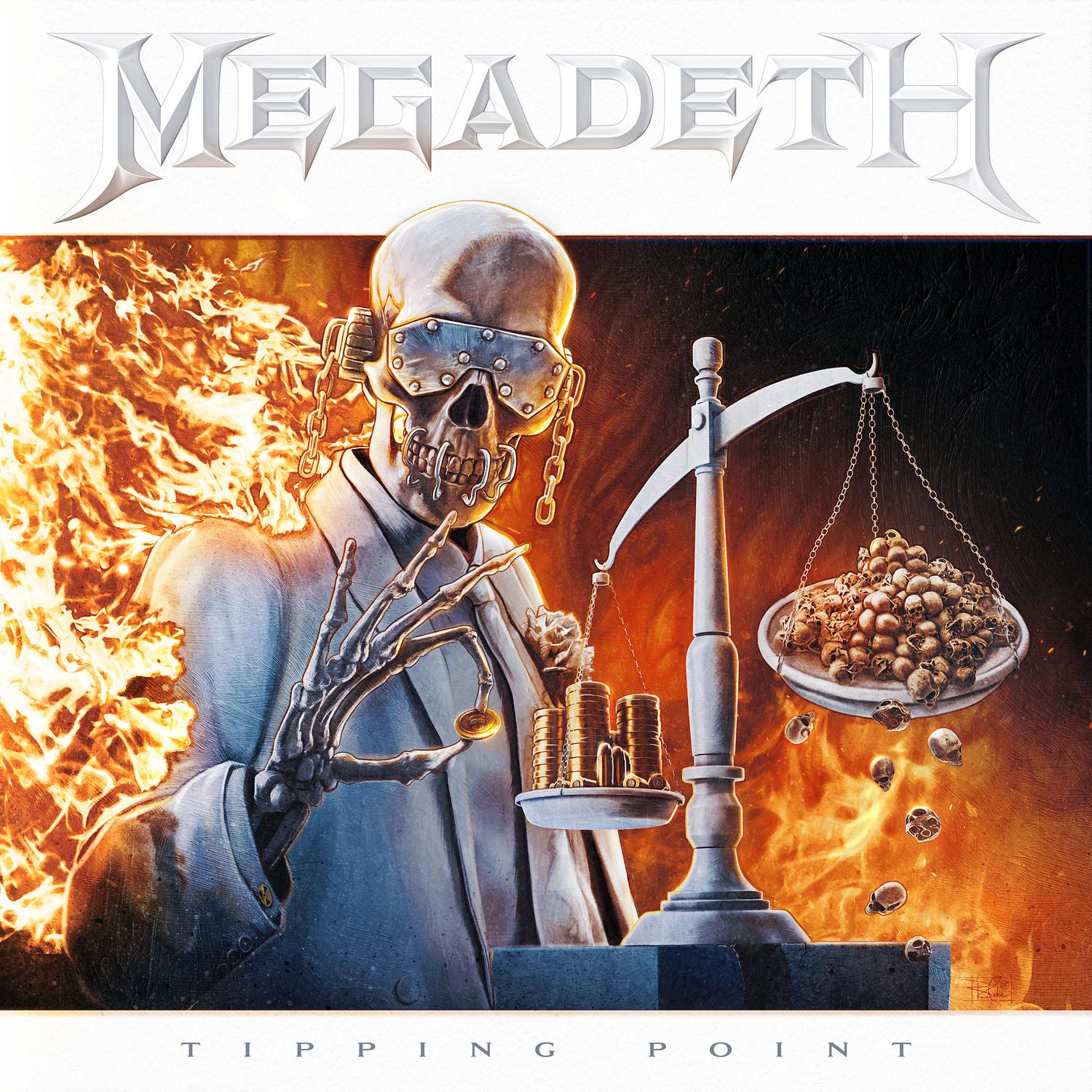
Tipping Point
2025-10-03
Megadeth个人资料
Origin
Los Angeles, California, U.S.
Genres
Thrash metal speed metal heavy metal
Years active
1983–2002 2004–present
Megadeth is an American thrash metal band formed in Los Angeles in 1983 by vocalist and guitarist Dave Mustaine. Known for their technically complex guitar work and musicianship, Megadeth is one of the "big four" of American thrash metal—along with Slayer, Anthrax, and Metallica[3]—and is credited with helping to develop and popularize the genre. Their music features intricate arrangements, fast rhythm sections, dual lead guitars, and lyrical themes such as war, politics, religion, death, and personal relationships.
In 1985, Megadeth released their debut album, Killing Is My Business... and Business Is Good!, on the independent record label Combat Records, to moderate success. It caught the attention of bigger labels, which led to Megadeth signing with Capitol Records. Their first major-label album, Peace Sells... but Who's Buying?, was released in 1986 and was a major hit with the underground metal scene. Band members' substance abuse issues and personal disputes had brought Megadeth negative publicity during the late 1980s. Nonetheless, the band went on to release a number of platinum-selling albums, including So Far, So Good... So What! (1988), Rust in Peace (1990) and Countdown to Extinction (1992). These albums, along with worldwide tours, brought them public recognition. Megadeth's most recent album, The Sick, the Dying... and the Dead!, was released in 2022. On August 14, 2025, Mustaine announced that the band's seventeenth studio album, Megadeth, and its supporting tour will be their last.
Megadeth has undergone frequent lineup changes throughout its 42-year career, with Mustaine being the sole consistent member of the band. The band temporarily disbanded in 2002 when Mustaine suffered an arm injury and re-established in 2004 without longtime bassist David Ellefson, who had taken legal action against Mustaine. Ellefson settled out of court and rejoined the band in 2010, but was fired in 2021 amid allegations of sexual misconduct. Megadeth's current lineup includes Mustaine, bassist James LoMenzo, guitarist Teemu Mäntysaari and drummer Dirk Verbeuren.
Megadeth earned platinum certifications in the United States for five of its sixteen studio albums,[4] and has received twelve Grammy nominations. Megadeth won its first Grammy Award in 2017 for the song "Dystopia" in the Best Metal Performance category.[5] The band's mascot, Vic Rattlehead, regularly appears on album artwork and live shows. Megadeth hosted their own music festival, Gigantour, several times from July 2005 to August 2013, and held its first MegaCruise in October 2019. As of 2023, the band sold more than 50 million albums worldwide.
History
1983–1985: Formation and Killing Is My Business
Dave Mustaine formed Megadeth in 1983, after being fired from Metallica.
On April 11, 1983, Dave Mustaine was dismissed from Metallica before the band recorded their debut album Kill 'Em All due to substance abuse and personal conflicts with James Hetfield kicking his dog. As Metallica's lead guitarist since 1981, Mustaine had composed some of the group's early songs and helped hone the band into a tight live unit.[7][8] Afterward, Mustaine vowed revenge by forming a band that was faster and heavier than Metallica.[9] On the bus trip back to Los Angeles, Mustaine found a pamphlet by California senator Alan Cranston that read: "The arsenal of megadeath can't be rid no matter what the peace treaties come to."[10] The term "Megadeath" stuck with Mustaine and he wrote a song with that title with the spelling slightly changed to Megadeth, which, according to Mustaine, represented the annihilation of power.[11]
After arriving back in Los Angeles, Mustaine began the search for new bandmates for his band. He formed the band Fallen Angels, which included Lor Kane on vocals, Robby McKinney on guitar and Matt Kisselstein on bass, in April 1983.[12] The first Megadeth drummer Dijon Carruthers also joined around this time.[13] The band's name was changed to Megadeth on Kane's recommendation.[14][a] As the founder, Mustaine added his new neighbors David Ellefson and Greg Handevidt to the band, who had moved from Minnesota to Los Angeles and played bass and guitar, respectively.[16] A demo was recorded by the lineup which had expanded to include Richard Girod on drums.[17] The band realized that they would have to retool some of the songs following the release of Metallica's debut album, in July 1983,[18] with "Mechanix" being the only Metallica-era song on Megadeth's debut album.[19] Megadeth songs from the summer of 1983 included "No Time", "Self Destruct", "Hair Pin Trigger", "Speak No Evil", "Eye for Eye" and "Heaven Knows".[17] "No Time" was an early title for "Set the World Afire", "Self Destruct" was the original title for "Mary Jane"[20] and "Speak No Evil" was the original title of "Looking Down the Cross."[21]
While Handevidt would only last a few months, Mustaine and Ellefson formed a tight musical bond. Despite his enthusiasm, Mustaine had trouble finding other members to fill out the lineup. He and Ellefson auditioned about 15 drummers, hoping to find one who understood meter changes in music.[22] After playing with Carruthers (who had rejoined the band in the fall)[23] and Girod,[17] they selected Lee Rauch in late 1983. The Mustaine/Rauch/Ellefson lineup was completed by the addition of Slayer guitarist Kerry King, with whom they rehearsed as well.[24]
Singers who temporarily joined the band included Billy Bonds[19] and John Cyriis, who would found Agent Steel after his firing from Megadeth.[25] Cyriis joined the band after Carruthers persuaded his other bandmates.[23] Following six months of trying to find a lead singer, Mustaine decided to perform lead vocals himself.[22]
In 1984, Megadeth recorded a three-song demo tape featuring Mustaine, Ellefson and Rauch.[26] The demo tape, Last Rites, was released on March 9, 1984. It featured early versions of "Last Rites/Loved to Death", "The Skull Beneath the Skin" and "Mechanix", all of which appeared on the band's debut album.[27]
The band was unable to find a compatible second guitarist. King filled in on rhythm guitar for several shows in the San Francisco area in 1984, starting with the debut gig on February 17 at Ruthie's Inn in Berkeley, California,[28] as well as a gig at The Keystone in Berkeley that April[29] and would play five shows in total with the band.[30] King went back to Slayer[31] and Rauch was briefly replaced with Minnesota drummer Brett Frederickson, with whom Ellefson had previously played.[32] Jazz fusion drummer Gar Samuelson joined the band in late 1984 and the band played a few gigs as a three piece band,[33] with Samuelson officially joining Megadeth on October 24, 1984.[34] Samuelson had previously been in the jazz band The New Yorkers with guitarist Chris Poland.[35] After seeing Samuelson perform with Megadeth as a trio, Poland went backstage and suggested an impromptu audition as lead guitarist for the band; he joined Megadeth in December 1984.[9]
After considering several labels, Mustaine signed the band to Combat Records, a New York-based Independent record label that offered Megadeth the highest budget to record and tour.[36] In 1985, Combat Records gave the band $8,000 to record and produce its debut album. After spending $4,000 of the budget on drugs, alcohol and food, the band fired the original producer and finished the recording themselves.[37]
Despite its low-fidelity sound,[38] Killing Is My Business... and Business Is Good! was relatively successful in underground metal circles and attracted major-label interest.[39] The band was calling itself State Of The Art Speed Metal.[40] Music writer Joel McIver praised its "blistering technicality" and stated that the album "raised the bar for the whole thrash metal scene, with guitarists forced to perform even more accurately and powerfully".[41] The front cover marked the debut of band mascot Vic Rattlehead, who regularly appeared on subsequent album artwork.[42]
Killing Is My Business... and Business Is Good! features "Mechanix", a song Mustaine wrote during his time with Metallica. Though Mustaine told the band after his dismissal not to use the music he had written, Metallica recorded a different version of the song, "The Four Horsemen", with a slower tempo and a melodic middle section.[43] The album also included a cover of Nancy Sinatra's "These Boots Are Made for Walkin' ", at a faster tempo and with altered lyrics. Megadeth's version generated controversy during the 1990s, when its writer, Lee Hazlewood, called Mustaine's changes "vile and offensive".[44] Under threat of legal action, the song was removed from pressings released from 1995 to 2001.[45]
In mid-1985, on a bill with Canadian speed metal band Exciter, Megadeth played its first North American tour: the Killing for a Living Tour. Guitarist Mike Albert replaced Poland, who was battling drug addiction.[46] Although Albert was originally supposed to be a permanent replacement,[36] Poland rejoined Megadeth in October 1985, shortly before the group began recording its second album for Combat.[47]
1986–1987: Peace Sells... but Who's Buying?
According to Mustaine, Megadeth was under pressure to deliver another successful album: "That sophomore offering is the 'be-all or end-all' of any band. You either go to the next level, or it's the beginning of the nadir."[48] Mustaine composed the music for the album, with the other members adding arrangement ideas.[49]
The album was produced on a $25,000 budget from Combat Records. Dissatisfied with its financial limitations, the band left Combat and signed with Capitol Records. Capitol bought the rights to the album, and hired producer Paul Lani to remix the earlier recordings. Released in late 1986, Peace Sells... but Who's Buying? has clearer production and more sophisticated songwriting.[50] Mustaine wanted to write socially conscious lyrics, unlike mainstream heavy metal bands who sang about "hedonistic pleasures".[51] The album was noted for its political commentary and helped Megadeth expand its fanbase.[52] The title track was the album's second single, and was accompanied by a music video that received regular airplay on MTV.[53]
In February 1987, Megadeth was the opening act on Alice Cooper's Constrictor tour,[54] and the following month began its first headlining world tour in the United Kingdom. The 72-week tour was supported by Overkill and Necros, and continued in the United States.[55] During the tour, Mustaine and Ellefson considered firing Samuelson for his drug abuse.[56] According to Mustaine, Samuelson had become too much to handle when intoxicated. Drummer Chuck Behler traveled with Megadeth for the last dates of the tour as the other band members feared Samuelson would not be able to continue.[57] Poland quarreled with Mustaine, and was accused of selling band equipment to buy heroin.[56] As a result, Samuelson and Poland were asked to leave Megadeth in 1987, with Behler becoming the band's full-time drummer.[55]
Poland was initially replaced by Jay Reynolds of Malice, but as the band began working on its next record, Reynolds was replaced by his guitar teacher, Jeff Young, when Megadeth was six weeks into the recording of its third album.[57]
1988–1989: So Far, So Good... So What!
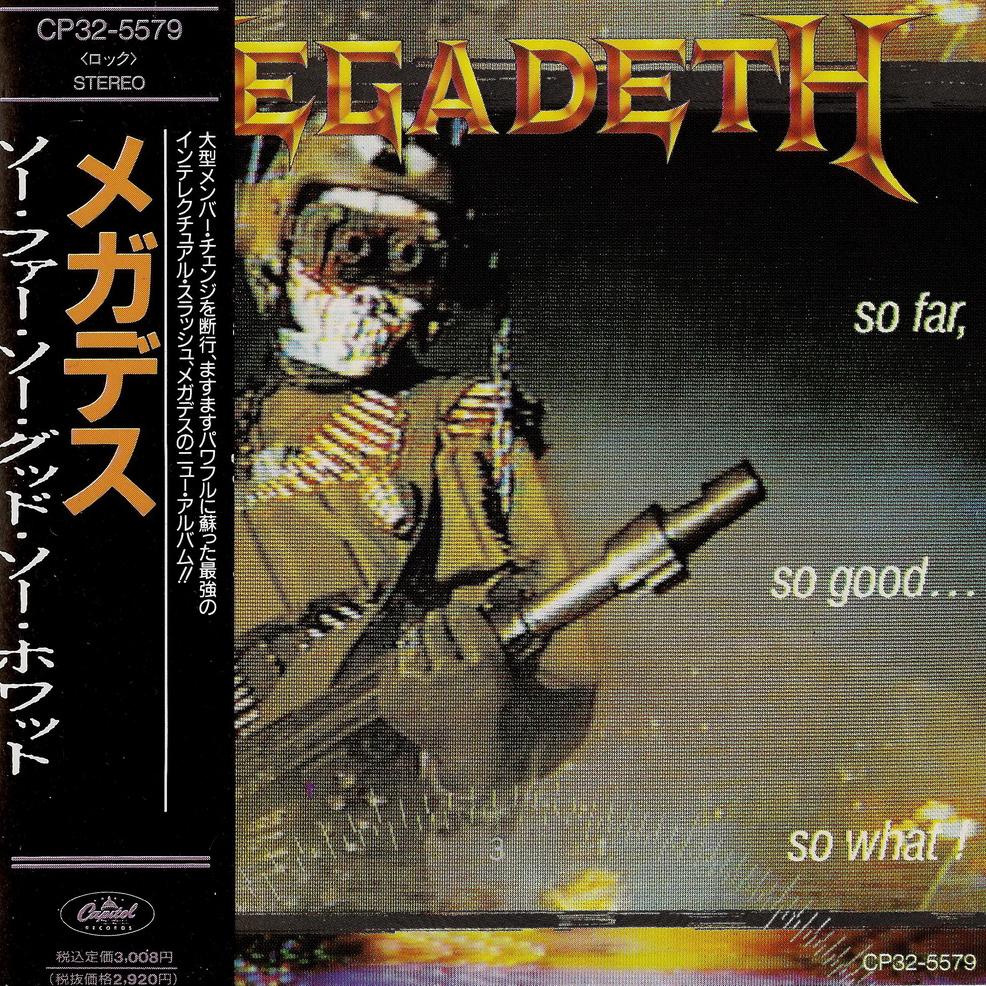
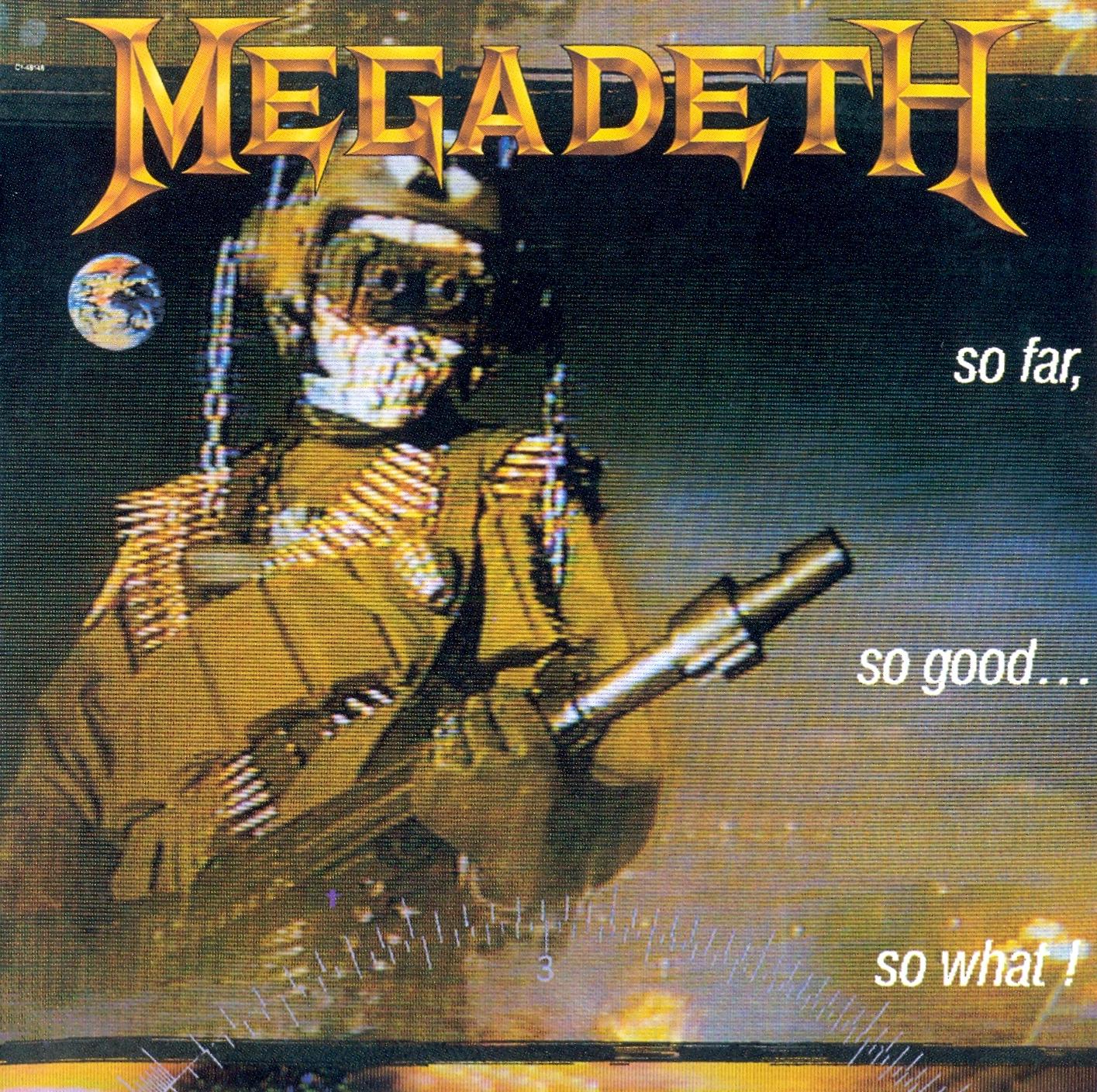
With a major-label budget, the Paul Lani-produced So Far, So Good... So What! took over five months to record. The production was plagued with problems, partially due to Mustaine's struggle with drug addiction. Mustaine later said: "The production of So Far, So Good... So What! was horrible, mostly due to substances and the priorities we had or didn't have at the time." Mustaine clashed with Lani, beginning with Lani's insistence that the drums be recorded separately from the cymbals, an unheard-of process for rock drummers.[58] Mustaine and Lani became estranged during the mixing, and Lani was replaced by Michael Wagener, who remixed the album.[59]
So Far, So Good... So What! was released in January 1988 and was well received by fans and critics.[60] The album featured a cover version of the Sex Pistols' "Anarchy in the U.K."; Mustaine changed the lyrics, later saying that he had simply heard them incorrectly. To support the album, Megadeth embarked on a world tour that lasted for nearly eight months. The band (along with Savatage) opened for Dio on their Dream Evil tour and supported Iron Maiden on their Seventh Son of a Seventh Son tour, both in the United States.[61] They also headlined a North American tour with Warlock and Sanctuary (whose debut album Refuge Denied was produced by Mustaine), and a European trek with Testament, Nuclear Assault, Flotsam and Jetsam and Sanctuary.[62]
In June 1988, Megadeth appeared in Penelope Spheeris' documentary The Decline of Western Civilization Part II: The Metal Years.[63] The documentary chronicled the Los Angeles heavy metal scene of the late 1980s, and Spheeris, who had directed Megadeth in the video for "Wake Up Dead", decided to include them to feature a more serious band in contrast to the glam metal groups.[64][65] Mustaine remembered the film as a disappointment, as it aligned Megadeth with "a bunch of shit bands".[66]
In August, the band appeared at the Monsters of Rock festival at Castle Donington in the United Kingdom, performing to an audience of more than 100,000. One show featured a guest appearance by Metallica drummer (and Mustaine's former bandmate) Lars Ulrich. The band was added to the Monsters of Rock European tour, but left after the first show due to Ellefson's drug problems, for which he was treated immediately.[67] Megadeth was replaced by Testament.[68]
Shortly after the Monsters of Rock appearance, Mustaine fired Behler and Young and canceled Megadeth's Australian tour. "On the road, things escalated from a small border skirmish into a full-on raging war," Mustaine later recalled. "I think a lot of us were inconsistent because of [drugs]."[69] During the tour, Mustaine noticed problems developing with Behler and brought in drummer Nick Menza as Behler's drum technician. As with Samuelson, Menza was expected to take over if Behler could not continue the tour. Menza replaced Behler in 1989.[70] Young's dismissal resulted from Mustaine's suspicions that he was having an affair with Mustaine's then-girlfriend, an allegation Young denied.[71]
The band was unable to quickly find a suitable replacement for Young. Although 1989 marked the first time since its inception that Megadeth did not tour nor perform at least one show, they recorded a cover version of Alice Cooper's "No More Mr. Nice Guy" which appeared on the soundtrack to the Wes Craven horror movie Shocker.[72] The video was directed by Penelope Spheeris, who recalled the filming as a "Herculean task" as Mustaine was unable to play guitar because of his drug addiction.[63] During the March 1989 auditions for a new lead guitarist, Mustaine was arrested for driving under the influence and possession of narcotics after crashing into a parked vehicle occupied by an off-duty police officer.[73] Mustaine entered court-ordered drug rehabilitation shortly afterwards, and became drug-free for the first time in ten years.[63]
1990–1991: Rust in Peace
With Mustaine sober, Megadeth continued searching for a new lead guitarist. Guns N' Roses guitarist Slash had been jamming with Mustaine and Ellefson, and although it seemed that he might join Megadeth, he remained with Guns N' Roses.[74] Dimebag Darrell of Pantera was offered the job, but the deal fell through after Mustaine refused his request to recruit his brother, Pantera drummer Vinnie Paul, as he had already hired Menza.[75] The offer was also extended to Criss Oliva who also declined as he did not want to leave Savatage.[76] Jeff Loomis, who would later go on to form progressive metal titans Nevermore, also auditioned though Mustaine deemed him too young to join as Loomis was only 18 at the time.[77]
Megadeth performing at the Sloss Furnaces in Birmingham, Alabama, in July 1991
Marty Friedman filled the guitarist position at the recommendation of Ron Laffitte, a member of Capitol management. Laffitte had heard Dragon's Kiss, a solo recording by Friedman when he was in Cacophony.[78] Mustaine and Ellefson were satisfied with Friedman's style and thought that he understood Megadeth's music.[79] With Friedman in the group, the band completed what fans consider the definitive Megadeth lineup.[80] The revitalized band entered the studio at Rumbo Recorders in March 1990 with co-producer Mike Clink to begin Megadeth's most critically acclaimed album, Rust in Peace. Clink was the first producer to complete a Megadeth album without being fired.[81] Its recording was documented in Rusted Pieces, a home video released in 1991 with six music videos and an interview with the band.[82]
Released in September 1990, Rust in Peace debuted at number 23 in the United States and number eight in the United Kingdom.[83][84] Mustaine had developed a writing style with a rhythmically complex, progressive edge, and the songs featured longer guitar solos and frequent tempo changes.[85] Described as a genre-defining work by Decibel,[78] the album solidified Megadeth's reputation in the music industry.[22] It features the singles "Holy Wars... The Punishment Due" and "Hangar 18", both of which were accompanied by music videos and became live staples. Rust in Peace received a Grammy nomination in 1991 for Best Metal Performance,[5][86] and was the group's third platinum album, certified in December 1994.[87]
Early in 1990, Megadeth joined Slayer, Testament and Suicidal Tendencies for the successful European Clash of the Titans tour, featuring several American thrash metal bands.[88] An American leg began the following year featuring Megadeth, Slayer and Anthrax, with Alice in Chains as a supporting act. The tour was considered a multi-headliner, as the three main bands alternated time slots.[89] In addition to the Clash of the Titans tour, Megadeth (along with Testament) supported Judas Priest on their Painkiller tour in North America late in 1990 and appeared at the second Rock in Rio festival in January 1991.[90] In July 1991 the song "Go to Hell" was featured in the film Bill & Ted's Bogus Journey and on its soundtrack.[91]
1992–1993: Countdown to Extinction
The music for Megadeth's fifth studio album was written in two different sessions. The first session occurred after the conclusion of the Clash of the Titans tour, while the second session happened in the fall of 1991 following a one-month break.[92] Recording sessions for the album began in January 1992 at Enterprise Studios in Burbank, California. Max Norman was chosen to produce, as the band was pleased with his mixing of Rust in Peace.[93] Megadeth spent nearly four months in the studio with Norman, writing and recording what became the band's most commercially successful album, Countdown to Extinction.[94] The album, whose title was suggested by Menza, features songwriting contributions from each band member.[95] Ellefson explained that the band changed its approach to songwriting for this album, beginning to write more melodic songs.[96]
"Symphony of Destruction"
Duration: 24 seconds.0:24
Countdown to Extinction's first single, "Symphony of Destruction", has become one of Megadeth's best-known songs with its concise structure and memorable hooks.[97]
Problems playing this file? See media help.
Released in July 1992, Countdown to Extinction entered the Billboard 200 chart at number two and was certified double platinum in the United States.[3][4][98] It received a nomination for Best Metal Performance at the 1993 Grammy Awards,[99] and its title track won a Genesis Award from the Humane Society in 1993 for raising awareness for animal rights issues.[100] Ellefson later said that he and Friedman were disappointed that Megadeth did not win the Grammy: "It was such a bizarre moment, because it was as if the amount of work it had taken to ramp up to that hopeful night was literally gone in a second."[101]
A world tour in support of the album was launched in late 1992, with Pantera and White Zombie as supporting acts.[101] The tour included a North American leg in early 1993, with Stone Temple Pilots as the opening act. One month into the leg, the remaining shows, including dates in Japan, were canceled when Mustaine returned to substance abuse, ending up in a hospital emergency room.[102] After seven weeks in rehab, Mustaine emerged sober again and the band returned to the studio to record "Angry Again". The song is featured on the soundtrack of the 1993 film Last Action Hero and received a Grammy nomination in 1994.[103]
During mid-1993, Megadeth performed at a number of shows with Metallica in Europe. The first was at Milton Keynes Bowl in England, and included Diamond Head.[101] In July, Megadeth was added as the opening act for Aerosmith's Get a Grip Tour, but was removed from the bill after three shows.[104] Aerosmith said that Megadeth was "dumped" because of Mustaine's erratic behavior, while Capitol Records said it was due to "artistic restrictions".[105] After the canceled US tour, Megadeth returned to the studio to record "99 Ways to Die", which appeared on The Beavis and Butt-Head Experience, a compilation album released in November featuring songs interspersed with commentary by the main characters of the animated series Beavis and Butt-Head. The song was nominated for Best Metal Performance at the 1995 Grammy Awards.[106] During these sessions, Megadeth recorded a cover version of Black Sabbath's "Paranoid", which appeared on the Black Sabbath tribute album Nativity in Black; it was nominated for a Grammy the following year.[107]
1994–1995: Youthanasia
In early 1994, Megadeth reunited with producer Max Norman for the follow-up to Countdown to Extinction. With three band members living in Arizona, initial work began at Phase Four Studios in Phoenix.[108] A few days into pre-production, problems with Phase Four's equipment forced the band to look for another studio. Mustaine insisted on recording in Arizona, but no suitable recording facility could be found. At Norman's request, the band built its own recording studio in Phoenix in a rented warehouse, later called "Fat Planet in Hangar 18".[109] During the studio's construction, much of the pre-production songwriting and arrangements were done at Vintage Recorders in Phoenix.[55] At Norman's suggestion, the tracks on Youthanasia had a slower tempo than previous albums, at about 120 beats per minute.[110] The band abandoned the progressive approach from its previous albums and focused on stronger vocal melodies and more accessible, radio-friendly arrangements.[111] For the first time, Megadeth wrote and arranged the entire album in the studio, including basic tracks recorded live by the entire band. The album's recording was video recorded and released as Evolver: The Making of Youthanasia in 1995.
On October 1, 1994, as part of the album's promotional efforts, the band launched Megadeth, Arizona, which is considered the very first official artist website ever.[112][113] It was conceived by Capitol's sales director Robin Bechtel with help from designer Wendy Dougan and copywriter Jane Bogart on a total budget of $30,000 granted by Capitol.[112][113] Megadeth, Arizona was conceived as "a virtual cybertown in cyberspace". It featured a chat room (Megadiner[113]), news about the band (Horrorscopes[113]), digital postcards and other types of content.[112][113]
After eight months of studio work, Youthanasia was released in November 1994. It debuted at number four on the Billboard 200 and charted in several European countries.[114] The album was certified gold in Canada the day it was released,[115] and was certified platinum in the US two months later.[4] Megadeth hired fashion photographer Richard Avedon to enhance the band's image. Avedon had the band members exchange their jeans and T-shirts for a more conscious appearance.[116] To promote Youthanasia, the band played a Halloween show in New York City called "Night of the Living Megadeth", which was broadcast live on MTV.[110] In November, the band performed twice on the Late Show with David Letterman, playing "Train of Consequences" on the first appearance and "A Tout le Monde" on the second.[117][118]
An eleven-month tour began in South America in November 1994. In 1995, Megadeth played in Europe and North America with several opening acts, including Corrosion of Conformity, Korn and Fear Factory.[119] The tour culminated with an appearance at the Monsters of Rock festival in Brazil, co-headlining with Alice Cooper and Ozzy Osbourne.[120] In January 1995, Megadeth appeared on the soundtrack of the horror movie Demon Knight with the song "Diadems".[121] In July, Megadeth released Hidden Treasures, an extended play featuring songs which originally appeared on movie soundtracks and tribute albums.[122]
1996–1999: Cryptic Writings and Risk
After completing the extensive world tour in support of Youthanasia, Megadeth took time off in most of 1996 and nearly broke up.[123] During this period, Mustaine began work on MD.45, a side project with vocalist Lee Ving of Fear. The majority of the songs on the album were intended for Megadeth, but due to the band almost disbanding, Mustaine decided to use them for MD.45 instead.[123] The duo hired drummer Jimmy DeGrasso, who had played with Alice Cooper on the South American Monsters of Rock tour earlier that year.[124] Marty Friedman built a studio in his new home in Phoenix and completed his fourth solo album, released in April 1996.[125]
In September 1996, Megadeth went to London to work on songs for the next album. The songwriting was closely supervised by new manager Bud Prager, who contributed musical ideas and lyrics; many lyrics and song titles were changed at his request.[126] Regarding Prager's influence, Mustaine later wrote: "I figured maybe this guy [Prager] could help me get that intangible number one record I so badly wanted."[127] The album, recorded in Nashville, was Megadeth's first collaboration with country pop producer Dann Huff, who had met Mustaine in 1990.[128]
Cryptic Writings was released in June 1997. The album peaked at number ten on the Billboard 200,[83] and was eventually certified gold in the United States. Its lead single, "Trust", became Megadeth's highest charting song on the Mainstream Rock Tracks at number five,[129] and was nominated for Best Metal Performance at the 1998 Grammy Awards.[130] Although all four singles from the album entered the top 20 on Billboard's Mainstream Rock Tracks chart,[131] press response to the album was mixed. The album featured a diverse set of songs which the Los Angeles Times described as a "rousing balance" between older material and experimental songs.[132] Asked about the album's eclecticism, Mustaine said that Cryptic Writings was divided into thirds. One part was based around faster, more aggressive material, another was "radio-orientated music like Youthanasia", and the final third was more melodic.[125]
After more than a year since the band's last concert, Megadeth returned as a live act in June 1997, beginning a world tour with the Misfits and touring in the United States with Life of Agony and Coal Chamber.[120] In July, the band participated in Ozzfest '98 but, halfway through the tour, Menza reportedly discovered a tumor on his knee and left to undergo surgery.[133] Jimmy DeGrasso, who had collaborated with Mustaine in MD.45, was hired to replace Menza for the remainder of the tour.[134] Though initially meant to be a temporary replacement, DeGrasso joined the band permanently after the tour. Mustaine later said that he dismissed Menza from the band because he believed the drummer had lied about having cancer.[75]
Following the band's mainstream radio success with Cryptic Writings, Megadeth again worked with Dann Huff on its eighth studio album. The band began writing in January 1999, supervised by manager Bud Prager, who was credited with co-writing five of the album's twelve songs.[135] With high expectations following the chart success of "Trust", Prager convinced Mustaine to grant Huff even more control over the album's recording, a decision Mustaine later regretted.[136]
Risk, released in August 1999, was a critical and commercial failure and led to backlash from many longtime fans. Although its two predecessors incorporated rock elements alongside a more traditional heavy metal sound, Risk was virtually devoid of metal.[137][138] About the band's musical direction, Dave Mustaine said: "We hit the nadir of our career with Risk, and I vowed after that we were going to get back to our roots. It took a little bit of time to do that."[139] Despite this, Risk was certified gold in the United States.[140][failed verification] The album's lead single, "Crush 'Em", appeared on the soundtrack for Universal Soldier: The Return and was used as an entrance theme for NHL hockey games and professional wrestling events.[141]
Guitarist Marty Friedman left Megadeth at the end of 1999, citing "musical differences".
On July 14, 1999, former drummer Gar Samuelson died of liver failure at age 41 in Orange City, Florida.[142] Eleven days later, during Megadeth's performance at Woodstock 1999, Mustaine dedicated "Peace Sells" to Samuelson's memory. That month, Megadeth also recorded a cover version of the Black Sabbath's "Never Say Die" for the second Nativity in Black tribute album.[143] The band began a world tour in support of Risk in September, playing with Iron Maiden during the European leg. Three months into the tour, Friedman announced his resignation from Megadeth, citing musical differences.[144] Mustaine later said: "I told [Marty] after Risk that we had to go back to our roots and play metal, and he quit."[145]
2000–2002: The World Needs a Hero, breakup, and hiatus
In January 2000, guitarist Al Pitrelli, formerly of Savatage and the Trans-Siberian Orchestra, became Friedman's replacement.[146] Megadeth returned to the studio in April to work on its ninth studio album. A month into production, the band received an offer to join the Maximum Rock tour with Anthrax and Mötley Crüe. Megadeth put the recording on hold and toured North America during the second quarter of 2000.[120] Early in the tour, Anthrax was removed from the bill, allowing Megadeth to play an extended co-headlining set.[147] The tour, however, suffered from poor ticket sales.[148]
After 15 years with Capitol Records, Megadeth left the label in July 2000. According to Mustaine, the departure was due to ongoing tensions with Capitol management.[149] Capitol returned the band's newest recordings and released a greatest hits album, Capitol Punishment: The Megadeth Years, with two new tracks: "Kill the King" and "Dread and the Fugitive Mind".[150] In November, Megadeth signed with Sanctuary Records. The band returned to the studio in October to finish its next album, The World Needs a Hero, which was near completion when Megadeth joined the Maximum Rock tour six months earlier. Following the negative response to Risk,[151] Mustaine fired Bud Prager and produced the album himself.[152] The songs were written by Mustaine alone, except for "Promises", which had contributions from Pitrelli.[153] Two days before the release of The World Needs a Hero, Megadeth appeared in an episode of VH1's Behind the Music showcasing Mustaine, Ellefson, several past members, and Mustaine's old Metallica bandmates James Hetfield and Lars Ulrich.[154]
The World Needs a Hero was released in May 2001 and debuted at number sixteen on the Billboard 200. It was banned in Malaysia when the national government determined that the album's artwork was "unsuitable for the nation's youth". Consequently, the band canceled its concert of August 2 in Kuala Lumpur.[155] The album marked Megadeth's return to a more aggressive sound after the stylistic variations of its previous two albums,[153] but critics felt it fell short of expectations.[156] Mustaine compared the album to a huge ship at sea, turning and trying to right itself to get back on course.[149] Its lead single, "Moto Psycho", reached number 22 on the Billboard Mainstream Rock chart.[157]
Mustaine dissolved Megadeth in 2002, following an arm injury that prevented him from playing guitar.
A European tour with AC/DC in support of The World Needs a Hero began in mid-2001, followed by an American tour with Iced Earth and Endo in September.[154] Mustaine allowed fans to choose the setlist in each American city.[155] However, the tour was cut short following the September 11 attacks; all dates were canceled, including a DVD shoot in Argentina. The band instead played two shows in Arizona on November 16 and 17, which were filmed and released as Megadeth's first live release, Rude Awakening.[158] That year, Killing Is My Business... and Business Is Good! was remixed and remastered; the reissue featured modified artwork and several bonus tracks.[159]
In January 2002, Mustaine was hospitalized for the removal of a kidney stone and was administered pain medication that triggered a relapse of his drug addiction. Following his stay, Mustaine checked himself into a treatment center in Texas. While there, Mustaine fell asleep with his left arm over the back of a chair, causing compression of the radial nerve. He was subsequently diagnosed with radial neuropathy, which left him unable to grasp or make a fist with his left hand.[160][161]
On April 3, Mustaine announced in a press release that he was disbanding Megadeth, as his arm injury rendered him unable to play guitar.[162] For the next four months, he had physical therapy five days a week, and slowly began to "re-teach" his left hand.[163] To fulfill contract obligations to Sanctuary, Megadeth released the compilation album Still Alive... and Well?. The first half of the album contains live tracks recorded at the Web Theatre in Phoenix, and the second half has studio recordings from The World Needs a Hero.[164]
Following nearly a year of recovery, including physical therapy,[165] Mustaine began work on what was to have been his first solo album. The recording sessions for the new material, with session musicians Vinnie Colaiuta and Jimmie Lee Sloas[failed verification], began in October 2003[166] and were completed in April 2004.[167] The project was put on hold when Mustaine agreed to remix and remaster Megadeth's eight-album back catalog on Capitol Records,[168] re-recording portions that were missing.[169]
2004–2005: Reformation and The System Has Failed
In May 2004, Mustaine returned to his solo project. Contractual obligations to the band's European label, EMI, resulted in the recording's release as a Megadeth album.[170] Mustaine reformed the band and contacted the fan-favorite Rust in Peace lineup to re-record backing tracks. While drummer Nick Menza agreed to return, both Marty Friedman and David Ellefson were unable to come to an agreement with Mustaine.[171] Menza was sent home shortly after rehearsals began, a few days before the start of a tour supporting Megadeth's upcoming album. Mustaine said Menza was insufficiently prepared for the physical demands of a US tour, and "it just didn't work out".[172] This was the first album without Ellefson. Chris Poland, who played lead guitar on Megadeth's first two albums, was hired to contribute guitar solos to the new album, working with Mustaine for the first time since the 1990s. Poland opted to serve only as a session musician, wanting to remain focused on his jazz fusion project OHM.[173]
A four-piece band cheering the audience at the end of a concert
Megadeth's 2004–2006 lineup at Sauna Open Air Metal Festival 2005: From left to right: Shawn Drover, James MacDonough, Dave Mustaine and Glen Drover.
The System Has Failed was released in September 2004. Critics heralded it as a return to form; Revolver gave the album a favorable review, calling it "Megadeth's most vengeful, poignant and musically complex offering since 1992's Countdown to Extinction".[174] The album marked a shift toward the band's earlier sound; journalist Amy Sciarretto of CMJ New Music Report wrote that the album contained "neo-thrash riffing with biting, politically charged lyrics".[175] The System Has Failed debuted at number eighteen on the Billboard 200[83] and was led by "Die Dead Enough", which reached number 21 on the US Mainstream Rock chart.[157] Mustaine announced that the album would be the band's last and would be followed by a farewell tour, after which he would focus on a solo career.[176]
Megadeth began the Blackmail the Universe world tour in October, enlisting touring bassist James MacDonough of Iced Earth and guitarist Glen Drover of Eidolon and King Diamond. Five days before the first show, Menza was replaced by Shawn Drover, who remained with the band as a regular member.[177] The band toured the US with Exodus and Europe with Diamond Head and Dungeon.[178][179] In June 2005, Capitol released a greatest-hits compilation, Greatest Hits: Back to the Start, featuring remixed and remastered versions of songs chosen by fans from Megadeth's Capitol albums.[180]
In mid-2005, Mustaine organized an annual thrash metal festival tour, Gigantour. Megadeth headlined the inaugural tour with acts such as Dream Theater, Nevermore, Anthrax and Fear Factory. Performances at the Montreal and Vancouver shows were filmed and recorded for a live DVD-and-CD set released in the second quarter of 2006.[181] On October 9, following the successes of The System Has Failed and the Blackmail the Universe world tour, Mustaine announced to a sold-out crowd at the Pepsi Music Rock Festival in Argentina that Megadeth would continue to record and tour.[182] The concert, held at Obras Sanitarias stadium in Buenos Aires in front of 25,000 fans, was filmed and released on DVD as That One Night: Live in Buenos Aires in 2007.
组合介绍
Megadeth是开创美国Thrash Metal重要乐队之一,由乐队的核心人物Dave Mustaine于1983年被Metallica 开除后建立的,作为一支成功的乐队,Megadeth在全球卖出超过2000万张专辑,连续5张白金销量专辑以及7 次格莱美Best Metal Performance提名。Megadeth同Anthrax,Slayer和Metallica并称为"Big Four of Thrash" 乐队。这支乐队至今已经发行了11张录音室专辑,6张现场专辑,2张EP以及2张精选专辑,曾获得格莱美奖提名。
说起Megadeth,人们便会想到那毫不羞涩的严厉得象刀片一样的吉他SOLO。那么就先从它的灵魂人物:Dave Mustaine说起。Dave Mustaine生于加州,最早参与的乐队是于1979年成立的后来曾一度闻名的Panic,1982年离开Panic同Lars Ulrich和James Hetfield共组Metallica。而后来因共所周知的原因离开Metallica,于1983年同贝司手David Ellefson、吉他手Kerry King以及鼓手Lee Rash共组Megadeth。后来Kerry King去了Slayer,而Chris Poland加入,鼓手的位置由Gar Samuelson取代。1985年5月Megadeth的第一张专辑问世,这就是Killing Is My Business... And Business Is Good! 1986年11月,Peace Sells... but Who's Buying?出版,从而引起广大金属迷的注意。1987年Chris Poland和Gar Samuelson被开除。Chuck Behler出任鼓手,而Jeff Young出任吉他手。1988年三月So Far, So Good... So What出版,并受到一致好评。1989年Chuck Behler和Jeff Young分别被开除,Marty Friedman成为Megadeth吉他手,Nick Menza出任鼓手,并于1990年10月出版了最著名的Rust in Peace。1992年七月出版Countdown to Extinction。1994年出版Youthanasia。1995年三月出版了一张在欧洲缩混的Hidden Treasures。1997年6月Cryptic Writings出版。1998年7月Jimmy DeGrasso取代Nick Menza出任鼓手。1999年8月31日,新专辑Risk出版。经过一系列新专辑推广后,跟随Megadeth征战10年的吉他手Marty Friedman为了自己音乐事业的发展而选择了离开Megadeth。Megadeth的灵魂人物——主唱Dave Mustaine就此事解释道:Marty是一个另人难以置信的神奇的吉他手,同时他也是Megadeth的一个核心。我们很遗憾他的离去,我们祝愿他一切顺利。曾是Alice Cooper、Savatage的吉他奇才Al Pitrelli补充了Megadeth吉他手的位置。
近日获悉,乐队与Capitol Records唱片公司的合作即将结束。Sanctuary Records唱片公司会成为其新的合作伙伴。预计10月24日推出的回顾专辑Capitol Punishment: The Megadeth Years将成为乐队在Capital Records的最后作品。签约新公司后乐队将要为其推出至少5张专辑。不过至于第一张专辑的录制时间与发行期限到目前为止还没有公开。